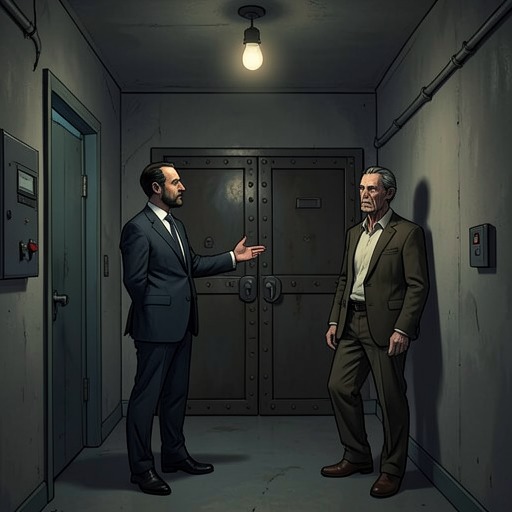
Newton Police Station
Defending JacobNewton Police Station serves two sharply different roles in the case: it is where investigators question Leonard Patz under observation, and where Jacob Barber is held after his arrest. The station’s interview room and lockup turn it into a place where police procedure and a family’s fear meet at close range.
Setting and Police Observation
When Andrew Barber arrives at the station, Patz is already seated in an interview room, facing a camera concealed in the face of a schoolhouse clock. The detectives are required to tell him about the recording and obtain his consent, yet the camera is hidden in the hope that suspects will stop thinking about it. Patz knows it is there and sits motionless, staring toward it.
The interview is also watched from outside the room. Patz’s image appears on a small computer screen in the detective bureau, where Newton and CPAC detectives gather; Paul Duffy and Nils Peterson sit on either side of him in the room, visible on the screen only when they lean into the camera’s frame. This arrangement makes the station a layered viewing space: the questioning happens behind a closed door, while a group of investigators watches its mediated image nearby.
Patz’s Interrogation
Duffy leads the questioning and asks Patz to recount what he remembers from the morning in question. The detectives’ watchful presence offers no immediate breakthrough: before Barber joins them, the bureau has seen little of interest. The scene establishes the station as a place of repeated questioning and scrutiny, but the camera and assembled observers do not by themselves resolve what happened.
Jacob’s Detention
Later, after Jacob is arrested, he cannot be bailed that night and is held in the station’s lockup, only a mile or two from the family home. Andrew and Laurie are permitted to see him briefly in a small, windowless visiting room. Jacob’s red-rimmed eyes and rigid effort to appear composed make the meeting an intimate counterpoint to the public machinery of the case: the station that holds a suspect also contains a frightened boy asking for his father.
Narrative Significance
The station’s significance comes from this juxtaposition. In Patz’s interview, police procedure is rendered through camera placement, monitored images, and detectives gathered around a screen; in Jacob’s detention, the focus narrows to a short family visit in a room without windows. The building thus connects investigation with confinement while keeping their different human stakes visible: observation does not guarantee certainty, and custody places the family close to Jacob but cannot spare them the force of his arrest.